
They also have a plan for a freight network:

You can read their policy brief here (pdf), though it's pretty much your standard pro-rail boilerplate. Which is to say: I heartily endorse it!
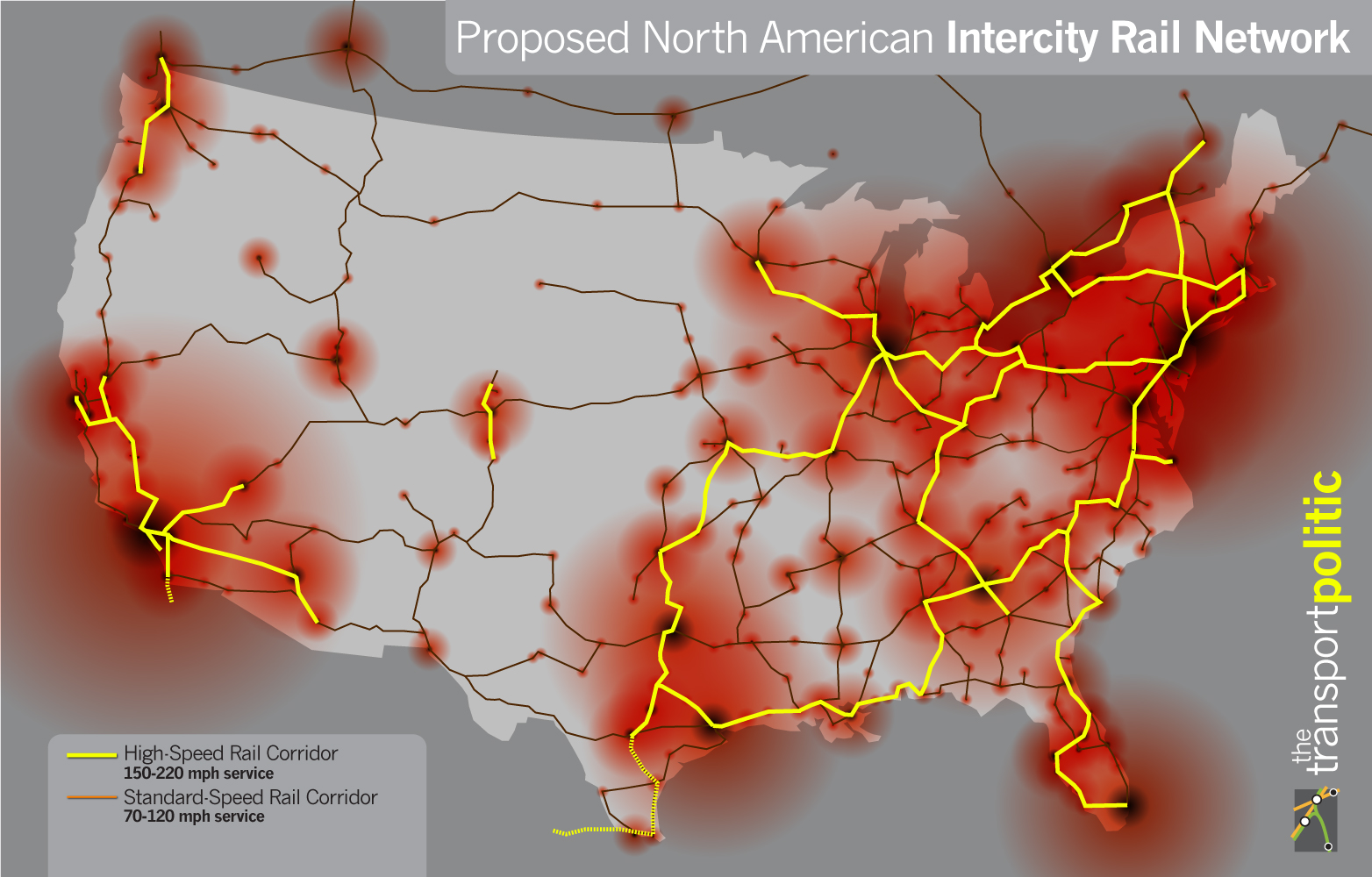

the transport politic’s proposal was informed by an analysis of potential travel between metro regions of populations greater than 100,000 and between 50 and 500 miles apart... The vast majority of train travel would occur on trains running at 150 mph or above on routes of 500 miles or less. Roads and airports along these corridors would be significantly decongested as more people choose to take the train instead of a car for short to medium distances (50-200 miles) and the train instead of the airplane for long distance (300-500 miles) travel...They also get into the nitty-gritty of how such a plan ought to be administered:
There is no transcontinental high-speed railroad proposed here because high-speed rail simply doesn’t attract particularly high ridership above the 500 mile travel distance; the best way to get from the East Coast to the West Coast will – and should, barring some unforeseen technological advance – remain via airplane...
In order to calculate the cost effectiveness of each route on the high-speed system, the transport politic used a relatively simple methodology based on travel between city pairs 50 to 500 miles apart. The calculations assume the following: that a big city to big city route attracts more passengers than a small city to small city route; that a big city to small city route attracts more passengers than a small city to small city route; that as distances increase, ridership decreases, though not proportionately. I recognize that these assumptions may be incorrect in many cases, but they provide a reasonable start for further research on this subject.
the transport politic’s suggestion is that the most appropriate way to get the ball rolling is to separate train operations – Amtrak – from track possession and maintenance by setting up a national infrastructure owner – let’s call it NatTrack. This agency would take hold of the Amtrak-owned Northeast Corridor and begin acquiring and assembling land for future high-speed rail corridors. Through eminent domain, it would also take possession of a large number of the nation’s freight lines, most of which are currently under-maintained and poorly managed, and begin converting them to standard-speed rail operations. NatTrack would manage route creation, not only in buying land and constructing track, but in prioritizing corridors to build new lines, deciding which to implement, and when.Here's their proposal for order of implementation:


The colors indicate the seriousness of planning for the corridors. Red lines represent projects that are partially funded or providing high-speed operation today; pink lines are under intensive state planning and likely to be among the first to receive stimulus funds; green lines are far off but not inconceivable; and blue lines are very unlikely to be built in the next few decades.The only existing "high-speed" rail line is the Northeast Corridor, aka the Acela, that runs between Boston and Washington, DC, and the modest speeds of that line barely qualify it for high-speed status. The first truly high-speed rail in the US is likely to be the line between San Francisco and LA. It will have speeds up to 220 mph, and a $10 billion bond was approved by voters last year to begin construction; other than the Northeast Corridor, it's the only red line on this map.
 high-speed rail development. Since political support will be needed to make good on these plans, that's significant, and could also lead to cascading momentum for the entire high-speed rail plan; if, for instance, progress begins to be made on the Southeast Corridor between DC and Charlotte, you can imagine an envious Atlanta wanting to get into the game, and an extension of the line to the Peach State would become all the more likely. And by the way, that's why I think the Infrastructurist's characterization of the blue lines in their map as "very unlikely to be built in the next few decades" may be a bit of an overstatement. I'm not sure how we could know what the political support for these plans might be in, say, 20 years, but it seems very possible that as progress gets made on some of these main lines, support for some of the secondary lines here will increase considerably. Another big spike in the price of oil, which would make both driving and flying more expensive, also might help to kick-start some of those plans.
 You'll note, however, that that sissy green shade on the old map has been replaced by a dynamic crimson; and, too, there are wavy ghost-lines to give a sense of integration to the plan. Change we can believe in!
What we're talking about is a vision for high-speed rail in America. Imagine boarding a train in the center of a city. No racing to an airport and across a terminal, no delays, no sitting on the tarmac, no lost luggage, no taking off your shoes. (Laughter.) Imagine whisking through towns at speeds over 100 miles an hour, walking only a few steps to public transportation, and ending up just blocks from your destination. Imagine what a great project that would be to rebuild America.I just have a couple of quibbles with the plan. One: connect Pittsburgh and Cleveland! They're only 130 miles apart by freeway, a distance that could conceivably make for a reasonable commute by high-speed rail. And it's a part of the country that could definitely use the short-term economic stimulus of building the line as well as the long-term benefit of increasing economic integration. Furthermore, such a line would connect the Midwest's Chicago Hub Network with the Northeast Corridor, and then we'd have something actually approaching a continental HSR system.
Now, all of you know this is not some fanciful, pie-in-the-sky vision of the future. It is now. It is happening right now. It's been happening for decades. The problem is it's been happening elsewhere, not here.
In France, high-speed rail has pulled regions from isolation, ignited growth, remade quiet towns into thriving tourist destinations. In Spain, a high-speed line between Madrid and Seville is so successful that more people travel between those cities by rail than by car and airplane combined. China, where service began just two years ago, may have more miles of high-speed rail service than any other country just five years from now. And Japan, the nation that unveiled the first high-speed rail system, is already at work building the next: a line that will connect Tokyo with Osaka at speeds of over 300 miles per hour. So it's being done; it's just not being done here.
There's no reason why we can't do this. This is America. There's no reason why the future of travel should lie somewhere else beyond our borders. Building a new system of high-speed rail in America will be faster, cheaper and easier than building more freeways or adding to an already overburdened aviation system –- and everybody stands to benefit.
 Austin and Dallas than it is with New Orleans. My car recently broke down in the town of Brenham, TX and I had occasion to get into a conversation with the local tow truck driver about patterns of megaregional integration in that part of the state (as one does with tow truck drivers). Specifically, he noted that the town had been growing in recent decades, and the reason was that people were finding they could commute from there to both Houston and Austin. I assure you there is no similarly oriented town between Houston and New Orleans. All of which is to say that - pace The Grateful Dead - Houston is not too close to New Orleans; it is close to the I-35 corridor megaregion of San Antonio-Austin-Dallas. The high-speed rail plan should reflect that reality.


In an amazing move towards converting their entire country towards sustainability, China is underway rebuilding its entire transportation system from the ground up. They now realize that cars and oil have no future. China is building an amazing 5,000 miles of brand new high speed trains comparable to the French TGV (200+ mph), all of which will be open for business in just 2 short years! In addition, China is building 36 brand new, full size metro systems - each to cover an entire city. The new Shanghai metro system will be the largest in the world when complete - larger than London's extensive system. China's massive, fast track green transportation construction project is unprecedented in the history of the world, and will completely transform China towards sustainability by drastically reducing their need for oil and cars.


