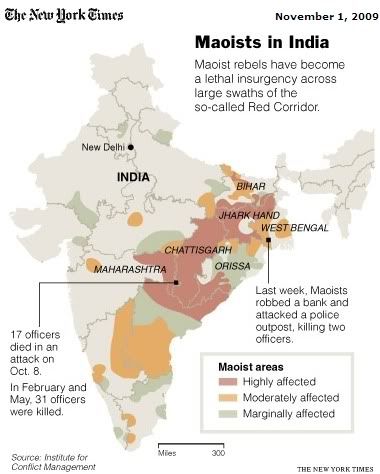
Says the Times:
India’s Maoist rebels are now present in 20 states and have evolved into a potent and lethal insurgency. In the last four years, the Maoists have killed more than 900 Indian security officers, a figure almost as high as the more than 1,100 members of the coalition forces killed in Afghanistan during the same period.The rebels claim to represent many of India's impoerished people, especially among its indigenous tribal groups. Despite their violent tactics, they have some support among intellectuals in India, including the writer Arundhati Roy. They're not to be confused with the above-ground Communist Party, which is a force in Indian politics.
If the Maoists were once dismissed as a ragtag band of outdated ideologues, Indian leaders are now preparing to deploy nearly 70,000 paramilitary officers for a prolonged counterinsurgency campaign to hunt down the guerrillas in some of the country’s most rugged, isolated terrain.


51 comments:
Why Maoism is actually an ideology that appears to be growing in some places is a mystery to me. Dear Maoists, you do realize that the genius of Mao's planning resulted in a famine that killed millions of people, right?
"indigenous tribal groups"
That's just silly.
The Indo-Aryans and Dravidians are not colonists (as has been conclusively proven by mitochondrial and y-chomosomal genetics), so other Indians living along side them are not more "indigenous".
The Indo-Aryans are primarily Y-chromosome C, H, J, and R1A. The Dravidians are primarily C, F, H, J, L, R1A, and RxR1. Indian women are generally groups M, R, and U.
R1A Y chromosomes are found throughout Siberia and Central Asia, as are U mitochondrial DNA. Y Chromosome L and H, and Mitochondrial DNA R are pretty unique to South Asia. The rest of the genetic material is common throughout South and East Asia, but not elsewhere.
GS - I know, right? From a branding perspective, it seems like you could do better than to hitch your cart to the name of an infamous genocidal tyrant.
AB - I know somewhere on the order of absolutely zero about Indian tribal politics. I would only say that I'm not sure how far mitochondrial analysis can go in explaining the cultural distinctions, not to mention the power dynamics, between various groups of people. And those are distinct from questions about historical migration.
But I'm intrigued by your comment about the Indo-Aryans and Dravidians not being colonists. What do you mean, exactly? And more importantly: do you have a map that illustrates the point?
Chachy:
For a long time, based on the silly Aryan hypothesis, it was thought that the northern Indians, especially the fairer skinned/higher caste elites, who speak various Indo-European languages related to Sanskrit, were colonizing "invaders" who had "enslaved" and massacred the native population - especially, the generally darker skinned Dravidian speakers (who mostly live in the south of India), who were assumed to be in the majority of the native population. Thus:
"It is often speculated that Dravidian languages were native to India."
http://en.wikipedia.org/wiki/Dravidian_languages
This was based on the thinking that if you spoke an Indo-European language, somehow you were from this mystical Aryan overlord group.
Based on this thinking, the non Indo-European speaking Dravidians were given special "opppressed" "tribal" status by modern India.
Dravidian Languages shown here:
http://en.wikipedia.org/wiki/File:Dravidische_Sprachen.png
Modern population genetics has conclusively proven that Indians are not closely related to Europeans, and that Dravidians and northern Indians are fairly closely related.
"Recent studies of the distribution of alleles on the Y chromosome,[1] microsatellite DNA,[2] and mitochondrial DNA [3] in India have cast overwhelmingly strong doubt for a biological Dravidian "race" distinct from non-Dravidians in the Indian subcontinent. The only distinct ethnic groups present in South Asia, according to genetic analysis, are the Balochi, Brahui, Burusho, Hazara, Kalash, Pathan and Sindhi peoples, the vast majority of whom are found in today's Pakistan."
http://en.wikipedia.org/wiki/Dravidian_homeland#Dravidian_homeland
The people's mentiond above live in western Pakistan and mostly speak tongues related those spoken in Iran, Afghanistan, and Tajikistan. The Brahui speak a Dravidian tongue, though, and the Sindhi speak an Indo-Sanskrit language.
Genetic maps of the world here:
http://www.scs.uiuc.edu/~mcdonald/WorldHaplogroupsMaps.pdf
http://sites.google.com/site/thelineagesofasia/populationmap
http://sites.google.com/site/thelineagesofasia/home
Y Chromsome maps of West Asia.
http://www.pnas.org/content/103/4/843.full?ck=nck
Genetics of India (more maps at link)
FYI ... I am type G and from Switzerland in the male line (pretty conclusively proven by testing people of my surname in the US and Switzerland). It seems my family ultimately originates from North Ossetia in the Caucusus Mountains though, as that is the origin of group G.
Interesting maps, Andrew. Still, even if the "Aryan hypothesis" is false, it may still be the case that Dravidian peoples in India are an underprivileged minority (and I don't know to what extent this is the case); genetic history doesn't really tell us anything about present-day social relations between groups (e.g., genetic distinctions had nothing to do with the US Civil War, the religious wards of Europe, or even ethnic conflicts in places like Rwanda and the Balkans, etc.).
Catatan Blogger Seo Matre Ajib for Catatan Blogger Seo Matre Ajib.
This is a really good read for me, Must admit that you are one of the best bloggers I ever saw.
Wow! This sounds new information that I really want to learn. Thanks for letting me know!
student loan|home improvement
Hey this is really nice information. I was looking for something similar like this. Thanks for this useful information.
finance information|Watch Movie Online 90210
I think this type of article is useful for many readers blog.Thank you so much.
student loan|home improvement
I finally found the information on this topic, ... I'll bookmark this page, ...
gadgets and tech tips|business review
Thank you very much. I am wonderring if I can share your article in the bookmarks of society,Then more friends can talk about this...
Home Improvement
your wesbite good, I enjoyed visiting here ....
Company the Film
I will be the subscriber pages of this website, .. because what you write really make my knowledge grow ...
Thanks for the article, this site really enriches me ...
Bluetooth Headphones
seemed to quite interesting, ... thank you for your article
hopeline
thank you for presenting the news that I needed ,....
thank you for presenting the news that I needed ,....
hope it will be better world
Plenty of good hermes handbag don’t just glance with fact cards. They as well surface by having an album that is the word for the assiduous action and also anxious data that perform their replica Hermes handbags a high-class. Alive some history with regards to artist and discount Hermes handbags artifact is as well actual handy.
lida is a new diet that creates an 11 day meal plan according to your tastes. Each day will have some kind of a theme. You will not have to count the amount of calories you consume or portion your meals. Rather, you will be encouraged to eat until you are satisfied with lida daidaihua but not the point of being stuffed. To illustrate clearly how daidaihua works, you might eat fish, chicken, fruit salad and cottage cheese for one day. You can eat as much as you want provided that you stop the very moment you feel full. Don't be worried about slimming capsule though. The entire day's meals consist primarily of proteins while it doesn't include that much carbohydrate. This kind of formula of lida slimming is important for one to lose excess fat without having to lose muscle as well. When you take in too little calories, your body will burn muscle and not fat.
There was a little pocket on the back of Chanel Wallet , where spare money could be stored, and the 2.55 boasted the now famous Mademoiselle lock, so named because Chanel handbags remained single throughout her life. Beneath the lock the front flap was ensconced a secret pocket, and it was there that Ms. Chanel handbag kept love letters from her many admirers. Adding a twist of scandal to the times, chanel watches was rumored that Nazi spy Hans Gunter von Dinklage was among her lovers.
Of course they want to make great profits by selling Tiffany co . These replicas are created either by using a mass production technique or by an individual silver bracelets designer who is striving to make a name for his services and capitalize on the original designs. Cheap Tiffany pendants makes a great success with the same looks and designs of Tiffany bracelets .
I read the article on New York Times website and the escalating fight against Maoist rebels in India really amazed me and worried me since I have some friend there
This is pretty interesting to know. By the way my husband who likes to get Generic Viagra use to visit India to help people and kids there.
indonewz fashionable tempat
I recently came across your blog and have been reading along. I think I will leave my first comment. I don’t know what to say except that I have enjoyed reading. Nice blog. I will keep visiting this blog very often.
http://www.factspenisenlargement.com
Berita Indonesia Terbaru, Film BF, Tube8, Tante Girang, Harga Mobil Bekas, Ramalan Bintang, Daftar Harga HP Bekas, Biro Jodoh Online,Cara Membuat Makalah, SM*SH, Liga Primer Indonesia, Top 40 Tangga Lagu Indonesia, Ramalan Togel, Ramalan Zodiak, Gosip Artis Terbaru, Foto Ibu Hamil, www.Games.co.id, Kumpulan Cerpen, Foto Cewek Cantik, Film Terbaru, New Car
Review, New Car Release, Profil SM*SH.
your wesbite good, I enjoyed visiting here ....
visit here to read great information
The beauty of these blogging engines and CMS platforms is the lack of limitations and ease of manipulation it seems like you could do better than to hitch your cart to the name of an infamous genocidal tyrant.
I absolutely match with everything you've presented us.
For a long time, based on the silly Aryan hypothesis, it was thought that the northern Indians, especially the fairer skinned/higher caste elites, who speak various Indo-European languages related to Sanskrit, were colonizing "invaders" who had "enslaved" and massacred the native population - especially Dating Tips . Fist Dating . First Dating Tips . Get Rid Of Hickey Tips . Rid of Blackheads Naturally
Hit upon not in how to accomplish a reverse telephone lookup or a cellular reverse phone lookup search or else yet a mobile phone number search search to locate absent who is trailing that character with the purpose of has been calling you this total point ok.
Invert cellular phone lookup sites akin to this one strength of character give you every kinds of mobile phone search facts so to facilitate you can finally find elsewhere their name, address, where they be alive, reverse phone lookup their current age and a lot other. So once you want with the purpose of expend a cellular phone number search in our day, barely execute persuaded to run through this beneficial tool to unearth not in each kinds of reorder telephone search details losing with the intention of character today.
I enjoy this nice swap telephone lookup otherwise telephone search before telephone number search spot. I can realize a imposing amount of reverse phone lookup things concerning turn around telephone search here now what time I check not at home this guide here.
Quite worthwhile material, thanks for your post.
I think people fear idea management and innovation because there's a significant number of ideas that simply won't plan out.......Nice statement.....keep posting
this day I've been searching for information on various issues, this I found very good and I would like to congratulate you for your work.
I think that this post is one of the best that i have read in my life, congrats you did a great job,.
the difference between the content spammers and most corporate innovators is that the smaller
I'm writing to you because I just came across a business that I think has great potential. It lets you save money on almost everything. Make money from almost everything,
If growth is important to a firm, and if growth is dependent on offering existing products and services to new customers
innovation is very natural and happens in the "real world" as new plants and animals colonize new ecological niches.
I wonder how you got so good. This is really a fascinating blog, lots of stuff that I can get into. One thing I just want to say is that your Blog is so perfect
We generally think most specifically about the risk associated with a new product introduction
I would be aware that as somebody who really doesn’t comment to blogs a lot (in actual fact, this may be my first put up), I don’t think the time period “lurker” is very flattering to a non-posting reader.
I wonder if our government will help India to control these guys!
GOOD article,
Obat Sekitar Kemaluan Mengeluarkan Cairan Nanah
Mengobati Kutil Pada Daerah Kemaluan Wanita
Cara Mengobati Kutil Pada Daerah Kemaluan Wanita
Mengobati Bintik Kutil Pada Daerah Kemaluan Wanita
Mengobati Benjolan Kutil Pada Daerah Kemaluan Wanita
Mengobati Kutil Pada Daerah Kemaluan Wanita Secara Alami
matur suwun
kutil di kemaluan wanita
kutil di kemaluan pria
menghilangkan kutil di kemaluan
cara mengobati kutil di kemaluan
obat wasir ampuh
obat ambeien di apotik
obat ambeien
obat ambeien tanpa operasi
obat untuk ambeien yang sudah parah
mengobati ambeien secara alami
mengobati kanker serviks
mengobati kanker payudara
obat kanker
Cara terbaik mengobati kutil kelamin sampai ke anus
Cara terbaik mengobati kutil kelamin dengan herbal
Cara terbaik mengobati kutil kelamin menyebar
Cara terbaik mengobati kutil kelamin sampai sembuh
Cara mengobati kutil kelamin tanpa resiko
Cara ampuh mengobati kutil kelamin tanpa resiko
Cara mengobati kutil kelamin yang benar tanpa resiko
Cara mengobati kutil kelamin tanpa resiko daging tumbuh
Cara mengobati kutil kelamin tuntas tanpa resiko
Cara mengobati kutil kelamin tanpa operasi tanpa resiko
Cara mengobati kutil kelamin menular
Cara mengobati kutil kelamin yang cepat menular
Cara aman mengobati kutil kelamin menular
Cara mengobati kutil kelamin menular yang benar
Cara mengobati kutil kelamin menular tanpa efek samping
cara mengobati kutil kelamin gatal
cara menyembuhkan kutil kelmain yang menular
obat kutil kelamin
Cara mengobati penyakit kutil kelamin yang menular
good
Obat Alami Kondiloma Akuminata
Obat Ampuh Kondiloma Akuminata
Obat Herbal Kondiloma Akuminata
Obat Tradisional Kondiloma Akuminata
Obat Kondiloma Akuminata Tanpa Harus Operasi
Obat Kondiloma Akuminata
Pengobatan Kondiloma Akuminata Tanpa Operasi
Obat Alami Kondiloma Akuminata Tanpa Operasi
Obat Alami Kondiloma Akuminata Kutil Kelamin
Obat Herbal Kondiloma Akuminata Kutil Kelamin
Obat Tradisional Kondiloma Akuminata Kutil Kelamin
Obat Ampuh Kondiloma Akuminata Kutil Kelamin
Obat Alami Kondiloma Akuminata Jengger Ayam
Obat Herbal Kondiloma Akuminata Jengger Ayam
Obat Tradisional Kondiloma Akuminata Jengger Ayam
Obat Mujarab Kondiloma Akuminata Jengger Ayam
Obat Alami Menghilangkan Kutil Kelamin
Obat Tradisional Menghilangkan Kutil Kelamin
Obat Herbal Menghilangkan Kutil Kelamin
Obat Mujarab Menghilangkan Kutil Kelamin
Obat Alami Untuk Menghilangkan Kutil Kelamin
Obat Alami Ampuh Menghilangkan Kutil Kelamin
Obat Alami Herbal Menghilangkan Kutil Kelamin
Obat Alami Tradisional Menghilangkan Kutil Kelamin
Thanks for sharing please help of my website matrimony rishta
Thanks for sharing please help of my website online rishta
Post a Comment