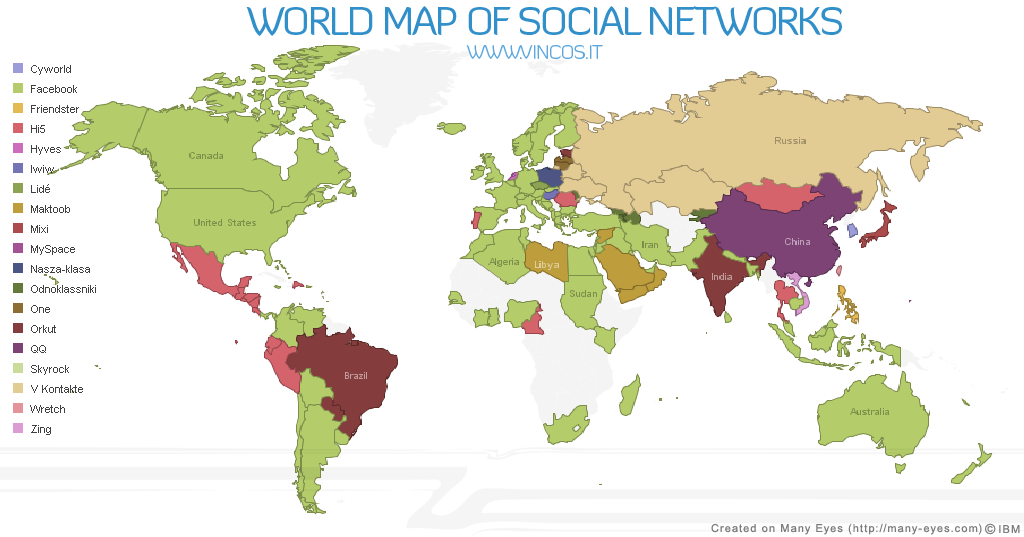
 With areas of dominance in North America, Latin America, Western Europe, Africa, and Southeast Asia, Facebook is the clear imperial hegemon in the world of social networking (and all that is despite its having one of the dumbest names in the business). But, according to Vincos, it is not actually the largest social networking site in the world; that superlative belongs to QQ, which dominates China with "300 million active accounts."
 Good ol' Friendster, meanwhile, has been pushed back - a bit oddly - to a final redoubt in the Philippines. Hi5, which I had never heard of, has probably the weirdest distribution of strength: it's tops in Mexico and Central America, Ecuador and Peru, Portugal, Cameroon, Romania, Thailand, and Mongolia - and nowhere else. I defy you to find the family resemblance that ties that group of countries together.
There are several country or language-specific networks that are king in just one nation: Hyves in the Netherlands, CyWorld in South Korea, iWiW in Hungary, and Mixi in Japan, among others. A few networks are popular across a cultural region, like Maktoob in the Middle East, V Kontakte in the core areas of the former Soviet Union, and Odnoklassniki in the more peripheral areas of same. MySpace, meanwhile, has fallen from its perch everywhere but Guam.


18 comments:
I'm surprised Russia isn't dominated by LiveJournal, to be honest.
I think this map underestimates the power of local social networks in Europe. E.g. StudiVZ is the dominant social network in Germany (with over 13 million users in Germany, Austria and Switzerland), Tuenti is the most used social network in Spain (whereas Facebook was unknown here until very recently), etc.
As the market is so language and culture-fragmented, European local social networks couldn't expand over the world the way Facebook has. And FB will probably gain the upper hand in the long term.
But for now, local networks are king in Europe.
thanks for sharing
Parcel natal
Rumah Sakit Mitra Kemayorans
belajar internet marketing
how to prevent premature ejaculation
I think people fear idea management and innovation because there's a significant number of ideas that simply won't plan out.......Nice statement.....keep posting
this day I've been searching for information on various issues, this I found very good and I would like to congratulate you for your work.
I think that this post is one of the best that i have read in my life, congrats you did a great job,.
the difference between the content spammers and most corporate innovators is that the smaller
I'm writing to you because I just came across a business that I think has great potential. It lets you save money on almost everything. Make money from almost everything,
If growth is important to a firm, and if growth is dependent on offering existing products and services to new customers
innovation is very natural and happens in the "real world" as new plants and animals colonize new ecological niches.
I wonder how you got so good. This is really a fascinating blog, lots of stuff that I can get into. One thing I just want to say is that your Blog is so perfect
We generally think most specifically about the risk associated with a new product introduction
I would be aware that as somebody who really doesn’t comment to blogs a lot (in actual fact, this may be my first put up), I don’t think the time period “lurker” is very flattering to a non-posting reader.
I saw so much useful data in this post!
I suppose everyone must browse on this.
good
Obat sakit Ambeien Stadium 4 Ibu Menyusui
Obat Ambeien Stadium 1
Obat Ambeien Stadium 2
Obat Ambeien Stadium 4
Obat sakit Ambeien untuk Ibu Hamil dan Ibu Menyusui
Obat Ambeien untuk Ibu Hamil
Obat Ambeien Ibu Menyusui
pengobatan Ambeien untuk Ibu Hamil dan Ibu Menyusui
Obat Ambeien dan wasir
Obat Ambeien Ibu Menyusui
Obat Ambeien yang Alami dan mujarab
pengobatan Ambeien Alami Ibu Menyusui
Pengobatan Ambeien Herbal Ibu Menyusui
Obat Ambeien Herbal
Obat Ambeyen Ibu Menyusui
Obat sakit Ambeien Herbal Ibu Menyusui
Obat Ambeien Ibu Menyusui
Obat Ambeien dr Tradisional
pengobatan Ambeien Tradisional Ibu Menyusui
Obat sakit Ambeien Tradisional Ibu Menyusui
Obat Ambeien Ampuh
Obat Ambeien Ibu Menyusui
Obat sakit Ambeien
pengobatan Ambeien Ampuh Ibu Menyusui
Obat Ambeien Alternatif
Obat Ambeien Ibu Menyusui
Obat Ambeien Ibu Alternatif
pengobatan Ambeien Alternatif Ibu Menyusui
obat kanker denature alami
obat kanker alami denature
obat kanker denature ampuh
pengobatan kanker denature
Obat Kanker Denature
Obat Kanker Denature Alami
pengobatan Kanker Denature
pengobatan Kanker Alami Denature
Nice Article,,,
cara mengobati kutil di kemaluan pria
cara ampuh mengobati kutil di kemaluan pria
cara herbal mengobati kutil di kemaluan pria
cara jitu mengobati kutil di kemaluan pria
cara cepat mengobati kutil di kemaluan pria
good
Obat Kutil di Sekitar Kemaluan
Jual Obat Alami Kutil di Sekitar Kemaluan
Jual Obat Ampuh Kutil di Sekitar Kemaluan
Jual Obat Kutil di Sekitar Kelamin
Dari Penis Keluar Nanah
Penis Mengeluarkan Nanah
Dari Penis Mengeluarkan Cairan Nanah
Dari Kelamin Mengeluarkan Nanah
Penis Mengeluarkan Cairan Nanah
Dari Penis Mengeluarkan Cairan Seperti Nanah
Dari Penis Keluar Cairan Nanah
Dari Kelamin Mengeluarkan Cairan Nanah
Dari Kelamin Mengeluarkan Seperti Nanah
Dari Penis Mengeluarkan Nanah
Dari Penis Mengeluarkan Nanah
Dari Penis Mengeluarkan Cairan Seperti Nanah
Penis Mengeluarkan Nanah Kental
Dari Penis Mengeluarkan Nanah Yang Kental
Dari Kelamin Mengeluarkan Nanah Kental
Dari Penis Mengeluarkan Cairan Nanah Kental
Obat Herbal Ambeien
Obat Herbal Ambeien Wasir Luar
Pengobatan Herbal Ambeien Luar
Obat Herbal Ambeien Luar Dalam
Post a Comment